


ASSAULT LAWYER IN WILLIAMSON COUNTY, TX
Georgetown Assault Lawyer
If you’ve been accused of assault in Georgetown or anywhere in Williamson County, your next steps could decide your future. Assault charges carry serious penalties that can affect your job, reputation, and freedom. Attorney Ryan H. Deck is an experienced, Texas Board-Certified criminal defense lawyer who provides aggressive, results-driven defense for clients facing assault allegations.

Skilled Defense for Assault Charges in Williamson County, TX
Texas law treats assault as a broad category, ranging from minor altercations to violent crimes involving deadly weapons. Depending on the circumstances, you could be facing a misdemeanor or a felony, both of which have lasting consequences.
Attorney Ryan H. Deck, a Board-Certified Criminal Defense Lawyer, has defended clients throughout Georgetown and Williamson County for nearly two decades. His understanding of Texas assault laws and trial experience gives clients a trusted advocate who knows how local courts handle these cases.
Types of Assault Charges in Texas
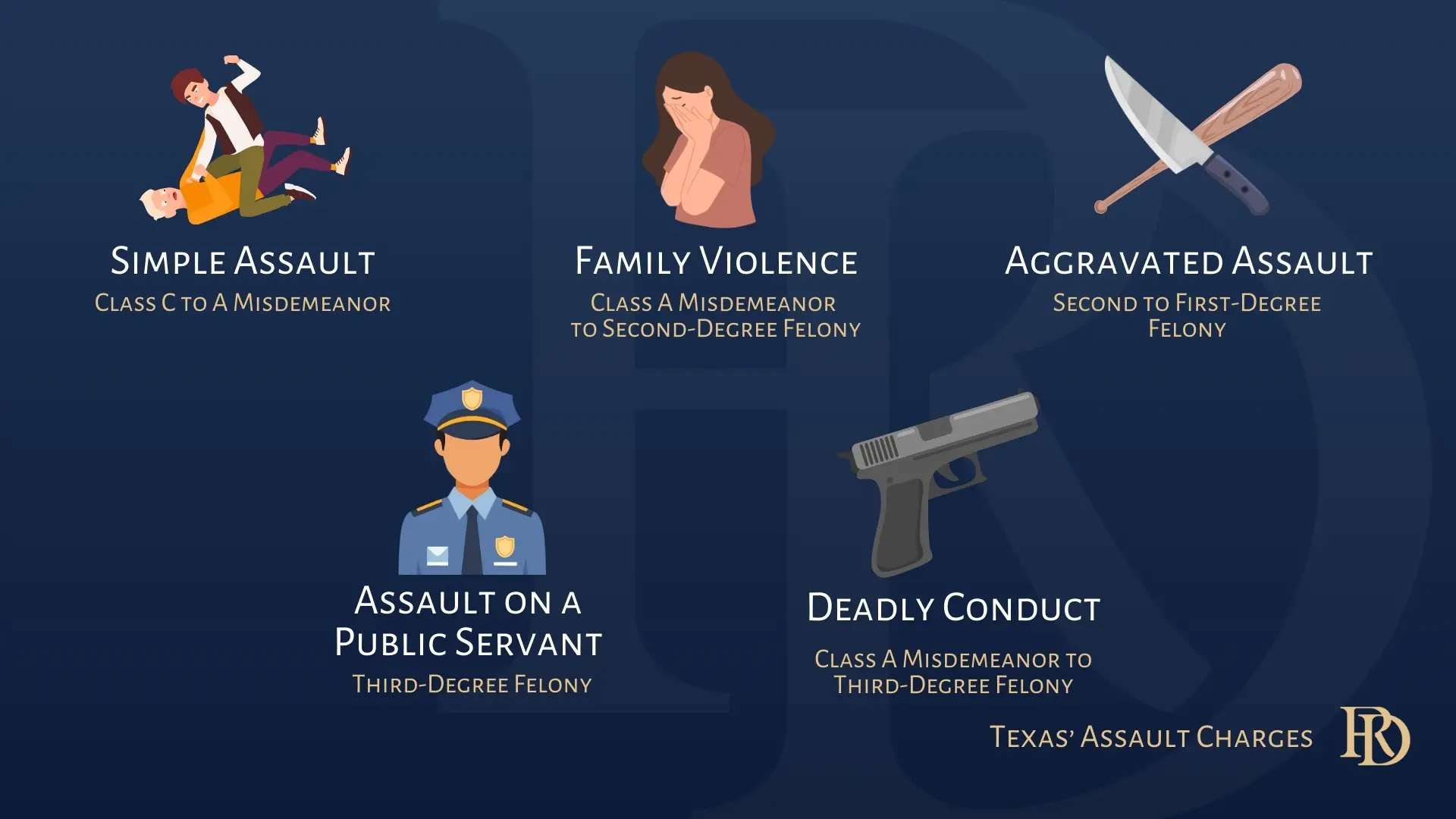
Under the Texas Penal Code, Chapter 22, the severity of an assault charge depends on the act itself, the alleged victim, and any aggravating factors. Common types include:
- Simple Assault: Intentionally or recklessly causing bodily injury, threatening harm, or making unwanted physical contact. Usually charged as a misdemeanor.
- Family Violence: Assault involving a family or household member, or someone in a dating relationship. Repeat convictions carry enhanced penalties.
- Aggravated Assault: Causing serious bodily injury or using a deadly weapon. Classified as a felony with significant prison exposure.
- Assault on a Public Servant: Attacking police, firefighters, or emergency personnel leads to heightened felony penalties.
- Deadly Conduct: Recklessly engaging in behavior that places others in danger, often involving a firearm or vehicle.
Penalties for Assault in Texas
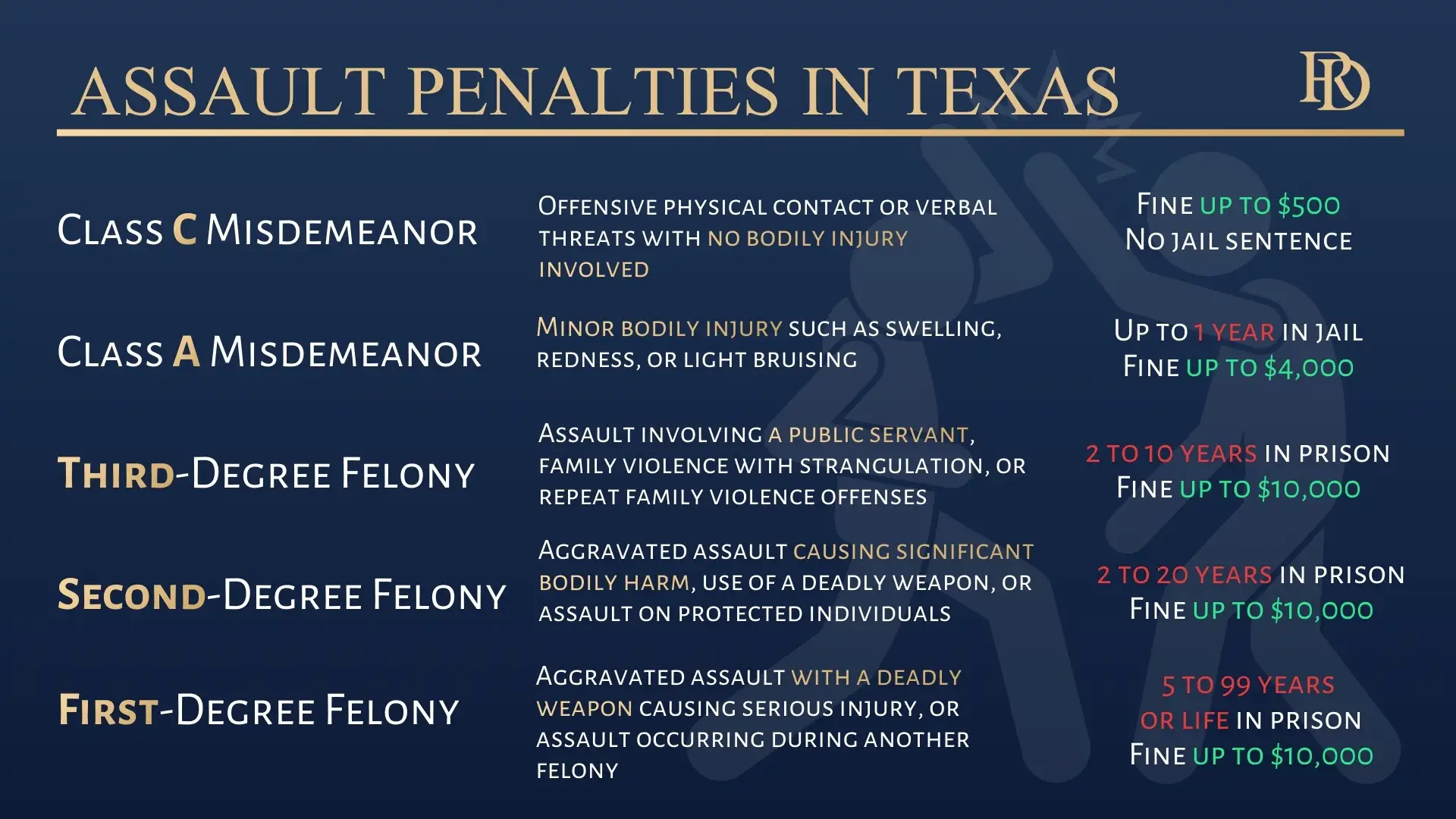
The punishment for assault depends on the nature of the assault and whether aggravating factors are involved:
- Class C Misdemeanor: Fine up to $500 for threats or offensive contact without injury.
- Class A Misdemeanor: Up to 1 year in jail and $4,000 fine for causing bodily injury.
- Third-Degree Felony: 2–10 years in prison and up to $10,000 fine for aggravated assault or public servant assault.
- Second-Degree Felony: 2–20 years in prison when serious bodily injury or a deadly weapon is involved.
- First-Degree Felony: 5–99 years or life in prison for aggravated assault with a deadly weapon causing serious injury.
Consequences of an Assault Conviction
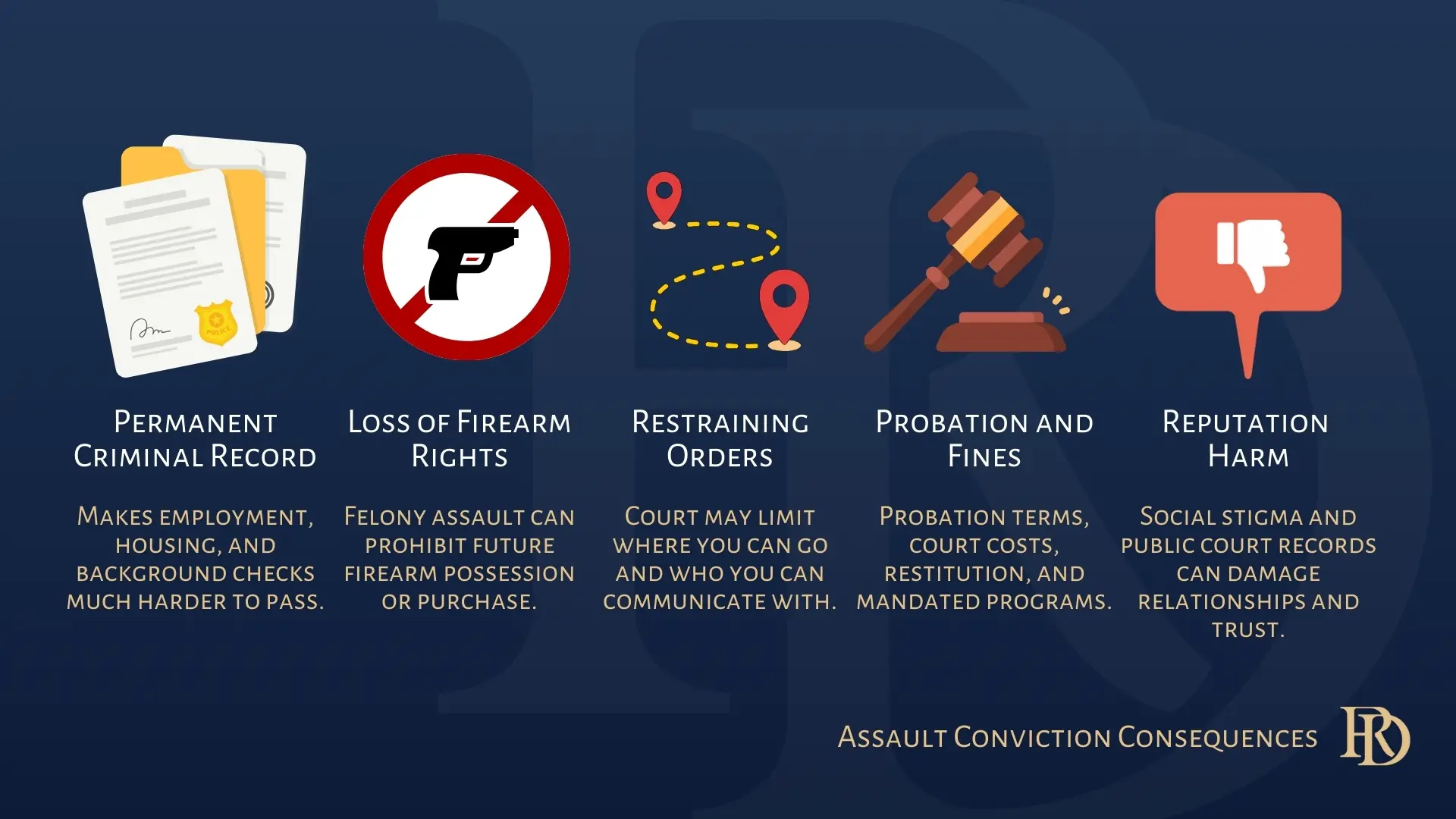
An assault conviction can affect every part of your life — even beyond fines or jail time:
- Permanent criminal record: Limits career and housing opportunities.
- Loss of firearm rights: Felony assault convictions can permanently revoke your right to own or carry guns.
- Restraining orders: Protective orders may restrict contact with family or your own home.
- Probation and financial penalties: Community supervision, service, and restitution may apply.
- Reputation harm: Public record of assault can follow you for years.
Defense Strategies for Assault Charges
Every case is unique, and the best defense depends on the circumstances. Common defense strategies include:
Self-Defense
Texas law allows the use of force when someone reasonably believes it is immediately necessary to protect themselves from bodily injury. In many assault cases, the incident begins with a confrontation, and the police arrest the person who appears to have “won” or who was standing when officers arrived, not necessarily the one who started the conflict.
A strong self-defense argument requires careful investigation. We analyze injuries, witness statements, 911 calls, video footage, and the history between parties. If evidence shows that you were attacked first, had no safe way to retreat, or believed serious harm was imminent, we will use that to fight for dismissal, acquittal, or reduced charges.
False Allegations
Assault charges often arise in emotionally charged situations — breakups, divorces, child custody disputes, or conflicts fueled by anger or revenge. In these situations, accusations can be exaggerated or entirely fabricated. Our role is to expose motive, inconsistencies, and factual inaccuracies through cross-examination, digital evidence, and timelines that challenge the credibility of the allegation.
We look for common indicators of false reporting, such as delayed reporting, inconsistent statements, lack of physical evidence, or communication suggesting ulterior motives. When false accusations are identified early, we can push for case dismissal or negotiate from a position of strength.
Lack of Intent

To convict someone of assault, the prosecution must prove intent, meaning that the act was done knowingly, intentionally, or recklessly. Many cases stem from accidents, falls, defensive reactions, or contact that happened during a chaotic situation. If contact was incidental or not meant to cause harm, the legal threshold for assault may not be met.
We build lack-of-intent defenses using context: witness testimony, physical evidence, body-cam footage, or expert medical review to show the event was accidental. Even in heated environments like bars or sporting events, lack of intent can be the difference between a conviction and a not-guilty verdict. When intent is unclear, we push aggressively for dismissal or reduced charges.
Mistaken Identity
Fast-moving, chaotic situations often produce unreliable eyewitness accounts. Stress, low lighting, intoxication, and crowd environments make misidentification common, yet many cases rely heavily on witness statements alone. We challenge identifications using police procedure records, lineup protocols, video footage, and forensic evidence (or lack thereof).
We also examine whether the accused matches descriptions given at the scene and whether police influenced witness memory. If there is no clear proof linking you to the incident, such as fingerprints, video, or injuries consistent with the allegations, we highlight those weaknesses to create reasonable doubt. A single flawed ID should not cost someone their future.
Consent or Mutual Agreement

In some situations, physical contact occurs through mutual participation, such as sports, sparring, mutual fights, or heated arguments, in which both parties engage willingly. If both sides consented or contributed to the escalation, the conduct may fall outside the legal definition of assault. Texas law recognizes that voluntary confrontation can reduce culpability or negate criminal responsibility entirely. Not every physical altercation is a crime — context matters.
Insufficient Evidence
Prosecutors must prove guilt beyond a reasonable doubt, and many assault charges lack reliable evidence. Injuries may be minor or inconsistent with the story. Witness accounts may conflict. Medical documentation may be vague. If the state cannot clearly prove what happened, how, and why, we push to suppress or exclude weak evidence.
We scrutinize everything: police reporting errors, improper statements, missing footage, biased witnesses, and forensic inconsistencies. Many assault cases collapse under scrutiny when the evidence is thin. When proof is weak, we seek a complete dismissal, reduction to lesser charges, or alternative resolutions that protect your record.

Target

Accused of Assault in Georgetown, TX? Take Action Now.
Assault charges can escalate fast — don’t face prosecutors alone. Ryan H. Deck delivers aggressive, smart defense aimed at reducing charges or securing dismissal.

Why Hire Attorney Ryan H. Deck
.svg)
Board-Certified Expertise
Certified by the Texas Board of Legal Specialization, recognized for extensive trial experience and deep legal knowledge.
.svg)
Proven Track Record
Successful results in Georgetown and Williamson County courts, including dismissals, acquittals, and reduced charges.
.svg)
Direct Representation
Ryan works personally on every case. Your case is never passed off to an associate.
.svg)
Strategic Defense Planning
Focused, evidence-based strategies aimed at protecting your freedom and record.
Protect Your Rights — Start Your Defense Now
Charged with assault in Georgetown or Williamson County? Complete this form for a free, confidential consultation with Ryan H. Deck. He’ll review your case, explain your options, and fight to protect your future.

FAQs
This is some text inside of a div block.
Can assault charges be dropped in Texas?
Yes, but only prosecutors can drop charges, not the alleged victim. Strong defense evidence can convince them to dismiss or reduce the case.
Is verbal assault a crime in Texas?
Only if it includes credible threats of immediate harm that make the victim fear for their safety.
What’s the difference between assault and aggravated assault?
Aggravated assault involves serious bodily injury or the use of a deadly weapon, making it a felony.
Can I be arrested for defending myself?
Yes, but you can assert self-defense as a legal justification. An experienced defense lawyer can help prove your actions were lawful.