


BOard-certified CRIMINAL LAWYER IN ROUND ROCK, TX
What Happens If I Get Deferred Adjudication on a Family Violence Charge?
In Texas, deferred adjudication can sound like a lifeline. You avoid a formal conviction, stay out of jail, and get a chance to prove yourself through community supervision. But if the charge involves family violence, things work differently. The most common misconception is that the charge will be erased from your record because you completed the process. It's not as neat as that.
In this article, our family violence defense lawyer will break down what it actually means, what happens during probation, and what the long-term impact looks like.
What Is Deferred Adjudication in Texas?
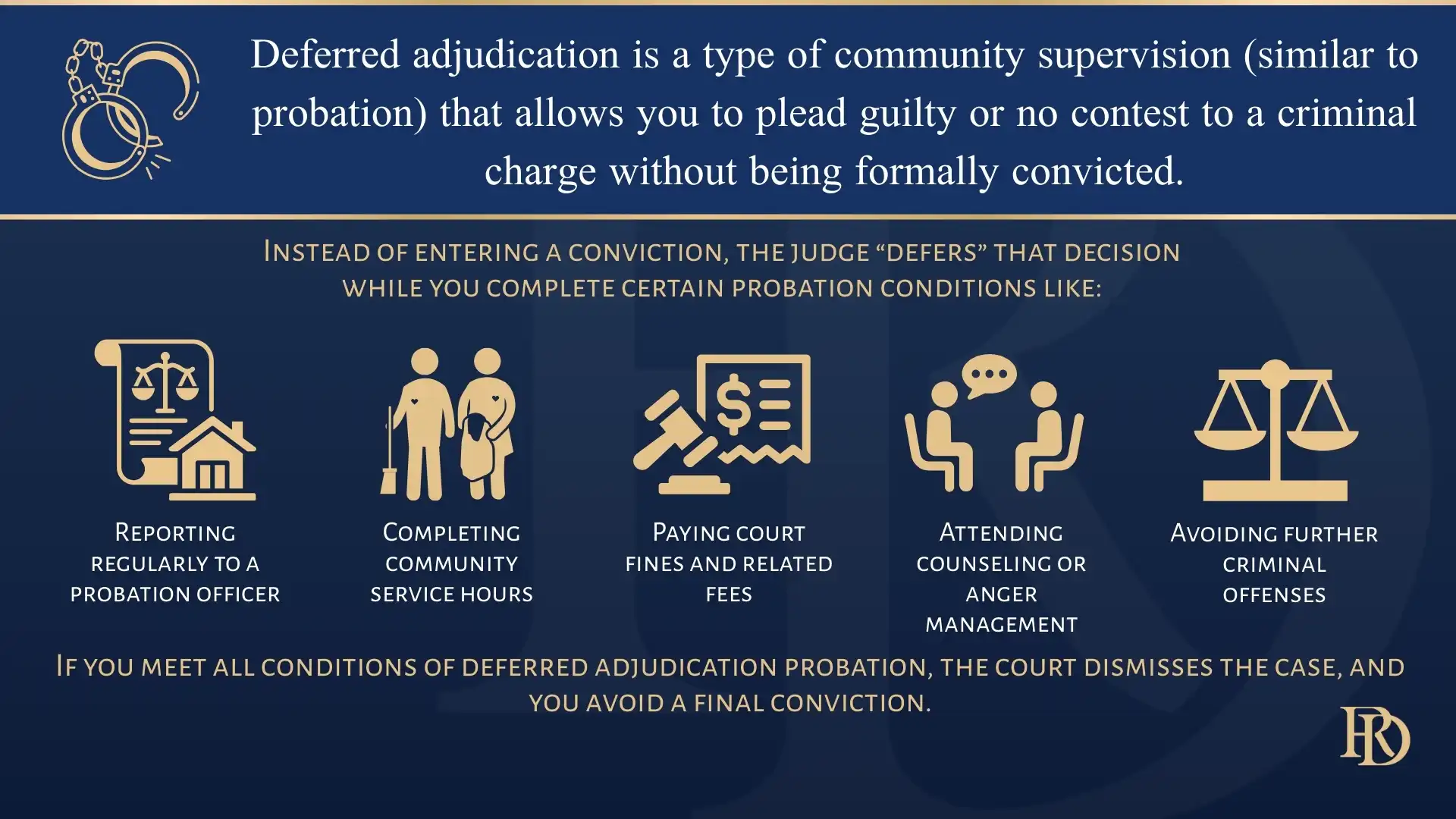
Deferred adjudication is usually offered to first-time offenders in Texas.
According to the State of Texas, deferred adjudication is a special form of judge-ordered community supervision (aka probation) that permits the defendant to accept responsibility for a crime without an actual conviction being placed on the record. Only a judge, not a jury, can grant deferred adjudication, so the prosecutor and the defendant must agree to waive a jury trial.
Those typically eligible are:
Any defendant charged with a misdemeanor crime other than driving/flying/boating while intoxicated. In addition, any defendant charged with a felony, except:
- Driving/flying/boating while intoxicated
- Intoxication assault
- Intoxication manslaughter
- A repeat drug offense enhanced with a drug-free zone finding, and
- A repeat sex offense (indecency with a child, sexual assault, or aggravated sexual assault)
However, this still requires the defendant to plead guilty or enter a no-contest plea. This locks down the possibility of dismissing the case outright.
A successfully completed deferred adjudication can often be sealed from public view with a non-disclosure once the waiting period is over. Sealing is on a case-by-case basis. Some deferred sentences are ineligible for non-disclosure.
For example, any crime involving family violence is ineligible for non-disclosure. It stays on your criminal history forever.
How Deferred Adjudication Works for Family Violence Charges

However, deferred adjudication is often called fool's gold in criminal defense. Texas law treats offenses involving family violence more strictly, so even if you successfully complete deferred adjudication, that case stays on your criminal history forever — and that’s where many defendants misunderstand the process.
You Can’t Get It Sealed or Nondisclosed
For most crimes, completing deferred adjudication makes you eligible to file a petition for nondisclosure (to seal the record). But under Texas Code of Criminal Procedure §411.074, any offense involving family violence cannot be nondisclosed — ever. That means your criminal record will always show that you were charged, pled, and received deferred adjudication on a family violence case.
You Still Face Restrictions
Even without a conviction, a deferred adjudication family violence case in Texas can affect your rights. You may:
- Lose the right to possess firearms under federal law
- Be disqualified from certain jobs or professional licenses
- Face obstacles in custody or domestic violence disputes
- Encounter background check issues for housing or employment
According to the Texas Department of Motor Vehicles, if your application reveals a conviction or deferred adjudication, this could be a basis for denying your license. This is always on a case-by-case basis. The state also provides a guide for all occupational license processes with deferred adjudication.
For employment, some employers may disqualify an applicant based on their family violence conviction. They can see you were charged with family violence, that you pleaded guilty to it, and at the very end, it says the charge is dismissed.
This doesn't instill much confidence, and the dismissal of your charge can be missed.
It Can Enhance Future Charges
If you’re accused of another crime involving family violence, prosecutors can use your prior deferred adjudication to enhance the next charge. What could have been a misdemeanor may be treated as a felony.
Probation Conditions You Might Face
Each probation term varies, but in family violence cases, the judge often imposes stricter requirements, such as:
- Completing a batterer intervention and prevention program (BIPP)
- Staying away from the alleged victim and their residence
- Undergoing drug or alcohol evaluation
- Random testing for controlled substances
- Restrictions on owning or using firearms
Violating any of these conditions can lead to revocation, where the judge ends your deferred probation and enters a conviction.
Why Judges and Prosecutors Use Deferred Adjudication
In many family violence cases, deferred adjudication is offered because it allows the court to balance punishment with rehabilitation. It can also help the prosecution avoid a jury trial while ensuring the defendant takes accountability. For first-time offenders, it’s often seen as being in the best interest of both sides — if handled correctly.
However, because of how Texas law restricts record sealing for domestic violence-related offenses, this “second chance” still comes with long-term consequences.
What Happens After You Complete Deferred Adjudication
If you complete your probation period successfully, the case is dismissed, but not erased. You’ll have technically avoided conviction, but the record will remain available to employers, law enforcement, and anyone performing a background check.
If you fail to meet the terms, the judge can enter a conviction and sentence you under the full range of punishment for that offense — up to a year in jail for a misdemeanor or several years in prison for a felony.
Alternatives and Legal Options

Depending on your circumstances, your attorney may explore options such as:
- Negotiating for a non–family violence charge that can later be sealed.
- Arguing for a dismissal before entering deferred adjudication.
- Requesting early termination of supervision in certain misdemeanor cases.
- Contesting a protective order that overlaps with probation terms.
Because every case has unique facts, an experienced criminal defense lawyer can evaluate which option best protects your long-term interests.
Partner with the Right Criminal Defense Attorney
A deferred adjudication on a family violence charge can feel like a relief at first — but it’s not a clean slate. The record stays with you, and the long-term consequences can affect your job, housing, and reputation.
Ryan H. Deck has been a community member for years and has played both prosecution and defense. He has defended clients across Williamson County facing family violence and domestic violence charges, guiding them through deferred adjudication probation, court hearings, and record issues. He can help you understand what this outcome really means for your future. Contact us today for a free, confidential consultation.


Texas Board-Certified Criminal Defense Attorney with over 20 years of experience
Target
Target

Facing a Family Violence Charge in Texas?
Get answers before you accept a plea. Contact Ryan H. Deck today for a free consultation and explore your best legal options.