


Board-certified criminal lawyer in round rock, TX
Ignition Interlock Devices: Everything You Need to Know
When it comes to DWI convictions in Texas, one of the most common penalties drivers face is the installation of an ignition interlock device (IID) — a car breathalyzer connected to the vehicle’s ignition system. But how do these devices actually work, who’s required to use them, and what happens if you fail a test?
Let’s break down the entire ignition interlock device program so you know what to expect, how to stay compliant, and how a DWI attorney can protect your driving privileges.
What Is an Ignition Interlock Device?
An ignition interlock device (IID) is a small electronic breathalyzer wired into a vehicle’s ignition system. Before starting the car, the driver must blow into the mouthpiece.
If the IID detects alcohol above a preset level (typically 0.02% BAC), the vehicle won’t start.
The device also requires random retests while driving (called “rolling retests”) to ensure the driver doesn’t consume alcohol after starting the vehicle. Each breath sample is logged and transmitted to the monitoring authority or probation department.

How Does an Ignition Interlock Device Work?
Here’s the basic process step by step:
- Provide a breath sample: The driver blows into the device before starting the car.
- Sensor detects alcohol: The IID measures the alcohol concentration in the sample.
- Ignition unlocks or locks:
- If alcohol is below the limit, the car starts.
- If it’s above the limit, the car remains locked, and the failed attempt is recorded.
- Random retests: During trips, the IID will request additional breath samples at random intervals.
- Data reporting: Results are electronically sent to the court, the probation officer, or the Department of Public Safety (DPS).
This system is designed to enhance road safety and deter repeat drunk driving offenses.
Who Is Required to Install an Ignition Interlock Device in Texas?
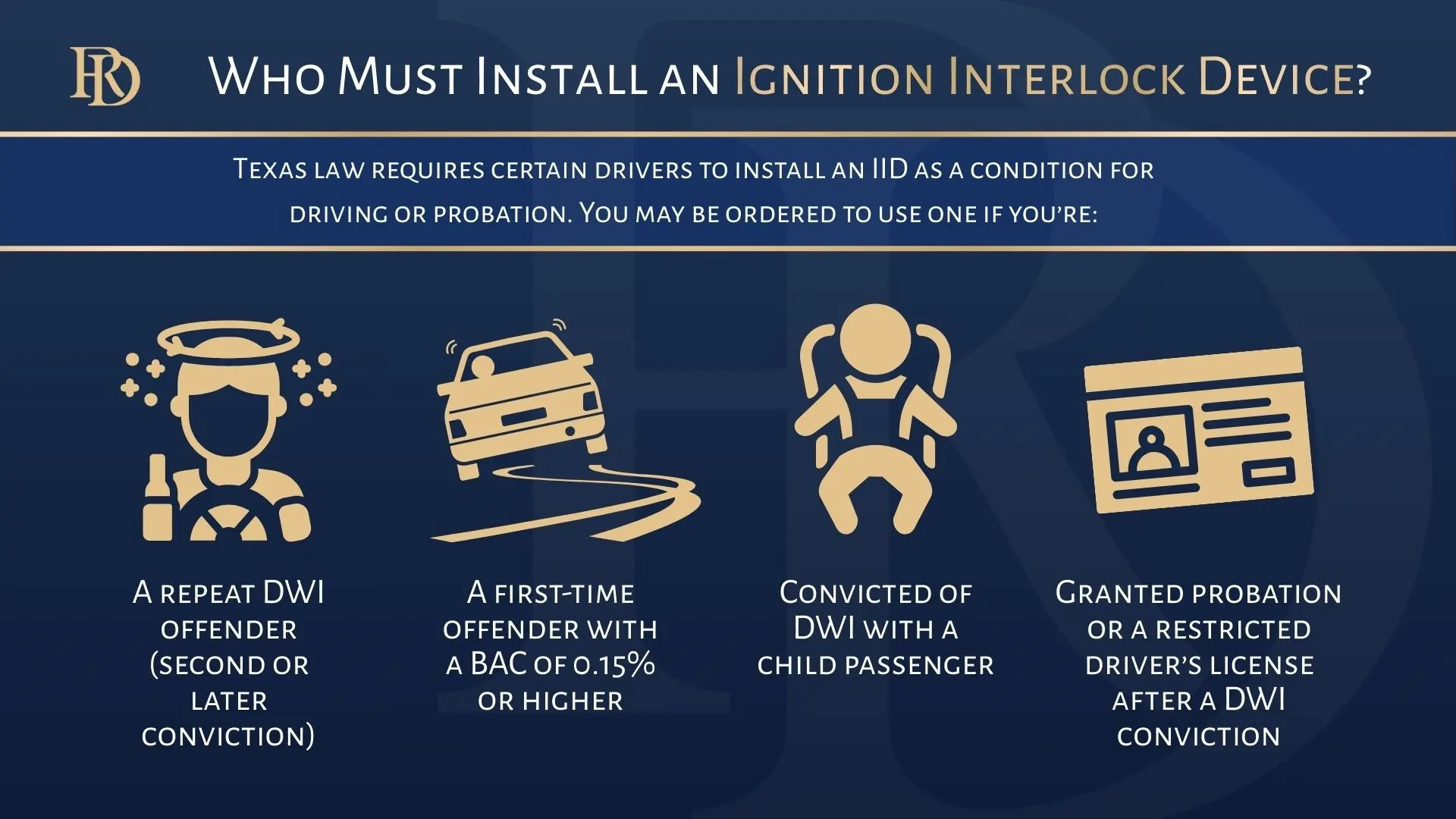
Under Texas ignition interlock laws, a court can require an IID for:
- All repeat DWI offenders (second offense or higher)
- First-time DWI offenders with a BAC of 0.15 or higher
- Drivers convicted of DWI with a child passenger
- Drivers granted probation or conditional license reinstatement
In most cases, if you’ve been convicted of driving while intoxicated, you must have the ignition interlock device installed on any vehicle you operate — even one owned by another person.
Ignition Interlock Device Costs and Installation
While it’s a court-ordered requirement, offenders are responsible for the cost of installation and maintenance.
Typical expenses include:
- Installation fee: $70–$150
- Monthly monitoring fee: $60–$100
- Removal fee: $50–$100
Low-income drivers may qualify for reduced fees or state assistance programs in certain counties.
Texas Ignition Interlock Device Program

The Texas Ignition Interlock Device Program is managed through both the court and DPS. Here’s how it works:
- After conviction or as a condition of probation, the court issues an IID restriction on your driver’s license.
- You must install the IID through an approved vendor and submit proof of installation.
- You’ll then obtain a restricted interlock license that allows you to drive only a vehicle equipped with the device.
- You must remain in compliance for the period ordered — typically at least one year for repeat offenders.
Failing to install the device, tampering with it, or driving without it can lead to license suspension or revocation of probation.
Violations and Consequences
Violating IID requirements can lead to severe consequences. Common violations include:
- Failing a breath test (IID detects alcohol)
- Missing a scheduled calibration or maintenance appointment
- Tampering or attempting to bypass the device
- Driving another vehicle without an IID installed
Depending on the violation, the court may:
- Extend your IID term
- Revoke probation
- Impose additional fines or jail time
Each failed test is automatically logged — even “accidental” ones, such as using mouthwash or eating certain foods before testing.
Can an Ignition Interlock Be Removed Early?
Yes — but only under limited circumstances.
A DWI defense attorney can file a motion to modify probation conditions requesting early removal if:
- You’ve maintained full compliance for a substantial period.
- You’ve had no positive tests or violations.
- You’ve completed the required alcohol education or treatment programs.
Ultimately, removal is at the judge’s discretion and depends heavily on your record and the attorney’s advocacy.
What Happens If You Fail a Breath Test?

If you blow above the threshold, the IID logs it as a violation and prevents the car from starting. Multiple failed attempts can trigger an alert to your probation officer.
In some cases, a single failed test may lead to increased monitoring, while repeated failures can result in probation revocation or even jail time.
Always wait at least 15 to 20 minutes after eating, drinking, or using mouthwash before providing a sample — this prevents false positives.
How Long Do You Have to Use an Ignition Interlock Device?
The duration depends on the offense level and court order:
- First-time DWI offenders: 6 months to 1 year
- Second offense: 1 to 2 years
- Third offense or higher: Up to the full probation period
The court may extend the term for any violations during the monitoring period.
Common Problems with Ignition Interlock Devices
While ignition interlock devices are meant to prevent drunk driving, they’re far from perfect. In fact, many drivers find themselves dealing with technical malfunctions, false positives, and unfair penalties — even when they haven’t had a drop of alcohol.
One of the biggest frustrations with ignition interlocks is that they don’t just detect alcohol from drinks — they detect any alcohol-based substance. This can include:
- Mouthwash, breath spray, or hand sanitizer
- Certain medications, especially cold or cough syrups
- Fermented foods like bread, vinegar, or ripe fruit
- Cleaning products or aerosols in the car
Even trace amounts of alcohol vapor can trigger a failed breath sample, which is automatically recorded and reported to your probation officer or the court. Multiple false positives can make it look like you violated your probation, putting your driving privileges and reputation at risk.
Ignition interlock devices rely on sensitive sensors and regular calibration. When not maintained properly, they can:
- Give inaccurate readings
- Fail to accept valid breath samples
- Request random retests too frequently or at unsafe times while driving
- Shut down the ignition system entirely, even after a compliant test
A single malfunction can be misinterpreted as noncompliance, leading to license suspension, extended IID requirements, or probation violations. Unfortunately, drivers often have to prove it was the device — not them — at fault.
Why Legal Representation Matters

Even though ignition interlock programs are standardized, judges have discretion in how they’re enforced — including:
- Deciding whether you must install one at all
- Setting the length of time you’re required to use it
- Approving early removal requests
- Reviewing violations or appeals
That’s why you need an experienced DWI defense attorney who can:
- Challenge false-positive results and prove device error
- File motions to shorten or remove the IID requirements
- Ensure technical issues don’t turn into probation violations
- Communicate directly with the court and monitoring agencies on your behalf
Without legal help, even a minor IID issue can spiral into suspension, jail time, or a permanent mark on your record. With proper representation, you have a voice and a chance to correct mistakes before they cost you your freedom.
Protect Your Future with Ryan H. Deck
If you’re facing a DWI charge and have been ordered to install an ignition interlock device, remember — this isn’t just a minor inconvenience. It’s part of a legal process that can affect your freedom, finances, and driving record. But with the right defense, you can protect your rights and minimize the lasting consequences.
Ryan H. Deck, a seasoned criminal defense attorney in Williamson County, has years of experience helping clients navigate DWI cases and ignition interlock requirements. He understands how Texas courts handle these situations and can help you challenge violations, request early removal, or fight for reduced penalties.
Don’t handle this process alone — one misstep could set back your recovery and your record. Contact us today for a free, confidential consultation and take control of your next steps.
FAQs


Texas Board-Certified Criminal Defense Attorney with over 20 years of experience
Target
Target

Facing a DWI Charge in Texas?
Learn how to protect your rights and avoid harsh penalties, such as ignition interlock installation. Talk to an experienced defense attorney today.
How long do I need an ignition interlock device after a DWI in Texas?
Typically, between 6 months and 2 years, depending on your offense and court order.
Can I drive someone else’s car if it doesn’t have an IID?
No. You can only legally drive vehicles equipped with an approved ignition interlock device.
Do first-time DWI offenders have to install an IID?
Yes, if your BAC was 0.15 or higher, or if the court includes it as a probation condition.