


Board-certified criminal lawyer in round rock, TX
What Are 3G Offenses in Texas?
In Texas, 3G offenses are among the most serious felony crimes you can be charged with. These offenses are named after a now-repealed section of the Texas Code of Criminal Procedure (Article 42.12(3)(g)), but the term is still widely used today.
If you're facing a 3G offense, you’re dealing with tougher sentencing laws, stricter parole rules, and limited probation options. In most cases, you must serve at least half of your prison sentence before becoming eligible for parole, and sometimes longer.
A 3G charge is not to be taken lightly. The penalties are severe, and the legal process is more complex than for other felonies. If you’ve been arrested or charged with one of these offenses, you need a strong criminal defense lawyer by your side.
What Makes an Offense a “3G” Offense?

While the term “3G offense” is an old nickname that still lingers in the legal world, the law itself now lives under Article 42A.054 of the Texas Code of Criminal Procedure. This section lists certain serious felony offenses that carry much stricter sentencing rules than ordinary crimes.
If your charge appears here or includes some of these elements, you must act quickly:
- Murder and capital murder
- Aggravated kidnapping
- Aggravated sexual assault and sexual assault
- Indecency with a child, sexual performance by a child
- Aggravated robbery
- Burglary of a habitation with intent to commit a felony
- Human trafficking and compelling prostitution
- Drug offenses where children are used or deadly weapons are involved
- Any felony offense where a deadly weapon was used or exhibited during the crime
Because the list is so broad in terms of types of acts, but very narrow in terms of context, it’s easy to misunderstand. For example, a basic robbery isn’t automatically 3G unless the statute triggers it. The presence of deadly weapons, certain types of victims, or aggravating factors often makes the difference.
Why Are 3G Offenses Treated Differently?
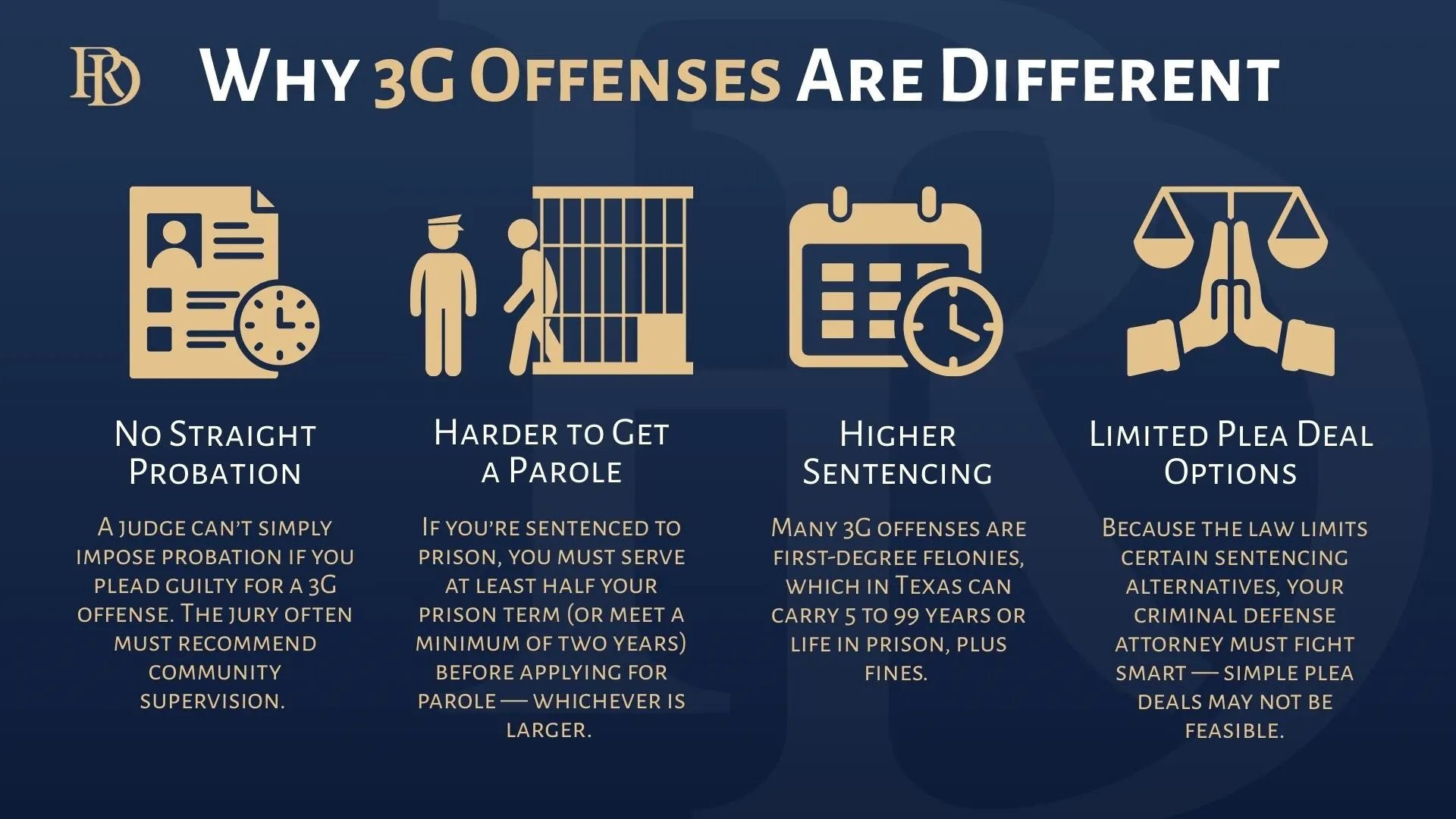
Think of regular felonies and then think of 3G offenses as the “premium” version — more risk, more rules, fewer break benefits. Here’s why they’re treated differently:
No Straight Probation
If convicted via plea or trial, a judge cannot impose straight probation (community supervision) for most 3G offenses. Only a jury can recommend probation under specific conditions.
Longer Time Before Parole
With ordinary felonies, parole eligibility might come after one-quarter of your sentence plus good conduct. For 3G felonies, you must serve at least half your sentence (or in some cases longer) before being eligible.
Heavy Sentences
Because many 3G offenses are first-degree felonies or higher, you’re looking at a prison range of 5 to 99 years — or life. Add in the sentencing enhancements and the possibility of mandatory minimums, and you see why these cases require serious defense.
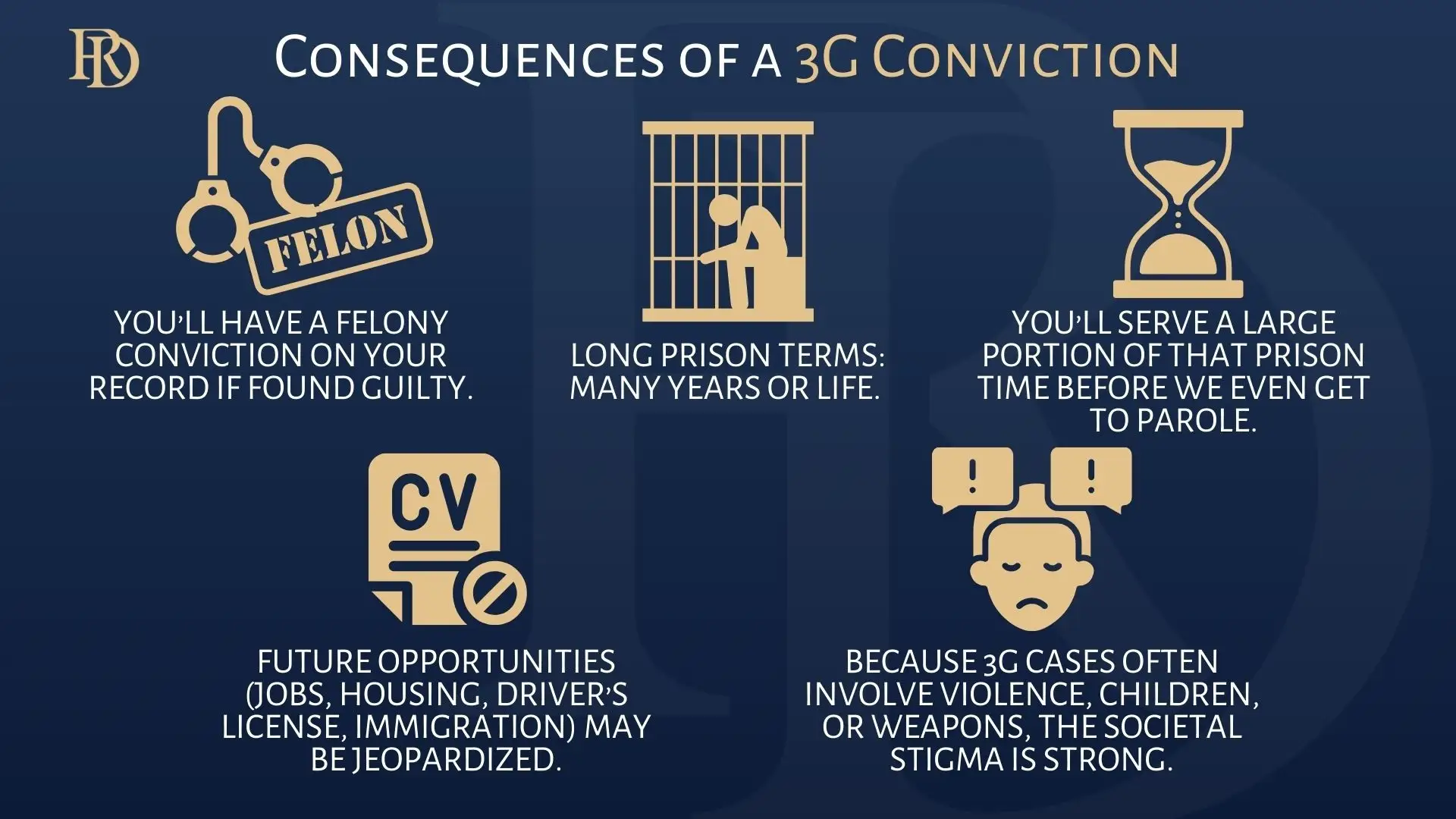
Collateral Consequences
The collateral damage of a 3G conviction, such as lost job opportunities, long-term stigma, risk of civil commitments, sex registry (in sexual-crime cases), or deportation (in immigration cases), is significantly greater than with non-3G felonies.
How the Legal Process Changes with 3G Charges
If you’re charged with a 3G offense, you’re walking into a legal procedure with different rules:
- The prosecution will likely treat the case like a serious felony from day one.
- You’re less likely to get a plea bargain that avoids all prison; the prosecution knows the leverage is substantial.
- Deferred adjudication (a type of probation alternative where the judge delays finding you guilty) may be possible, but it is still limited.
- Your lawyer must be ready for trial. The threat of going to a jury is real.
- Motion hearings, detailed evidence review, and expert testimony are more crucial. The experienced attorney you choose makes a dramatic difference.
What to Do If You’re Facing a 3G Charge
If you’re charged with or under investigation for a 3G offense, know this: you need an experienced attorney immediately — someone who understands 3G classification, Texas law, and how to fight high‑stakes cases.
Here’s how you move forward:
- Don’t speak to law enforcement without legal counsel. Hire an attorney.
- Ask for discovery: you must get the evidence the prosecution has.
- Have your attorney review plea options and understand what you’re giving up.
- Build your defense based on the tools available: challenging weapon findings, proving lack of intent, or negotiating for lesser charges if possible.
- Plan for the worst-case scenario but work toward the best possible outcome.
Your case requires more strategy than some everyday criminal offense. The stakes are too high for a“wait and see” approach.

Don’t Accept a 3G Charge Without a Fight
A 3G offense in Texas isn’t just another felony. When the law places your charge in that category, everything, from arrest to parole, takes on a higher level of risk. If you’re facing such charges, don’t assume you can handle it alone.
Ryan H. Deck is a seasoned criminal defense attorney specializing in serious felony offenses in Williamson County, Texas. If you’ve been charged with a 3G offense, or fear you might be, we’re here to protect your rights, build a robust defense, and fight for your future. Contact us for a free, confidential consultation.
FAQs


Texas Board-Certified Criminal Defense Attorney with over 20 years of experience
Target
Target

Take Control of Your Defense Today
Don’t let a 3G charge define your future. Contact Ryan H. Deck for a free consultation and get the skilled representation your case demands.
Is injury to a child a 3G offense in Texas?
Yes. Injury to a child, elderly individual, or disabled person is listed under Article 42A.054(a)(10) of the Texas Code of Criminal Procedure, making it a 3G offense. Because it involves harm to a vulnerable victim, it carries harsher sentencing rules and restrictions on probation and parole eligibility.
Can a 3rd degree felony be dropped to a misdemeanor in Texas?
It’s possible, but it depends on the case. A third-degree felony can sometimes be reduced to a Class A misdemeanor through a plea bargain or charge reduction if the evidence is weak, the offense is nonviolent, or your attorney successfully negotiates with the prosecution. However, 3G offenses rarely qualify for this kind of reduction due to their severity.
Is intoxication assault a 3G offense in Texas?
Yes. Intoxication assault, which is causing serious bodily injury to another person while operating a vehicle under the influence, is a 3G offense. This means you’re not eligible for judge-ordered probation, and if convicted, you must serve at least half of your prison sentence before you're considered for parole.
Is intoxication manslaughter a 3G offense in Texas?
Yes. Intoxication manslaughter (causing someone’s death while driving intoxicated) is also a 3G offense. It’s treated as a second-degree felony under Texas law, with no eligibility for straight probation and significant restrictions on parole.
Is continuous family violence a 3G offense in Texas?
No. Continuous family violence, while still a serious third-degree felony, is not classified as a 3G offense. However, a conviction still carries severe consequences, including potential jail time, loss of firearm rights, and long-term effects on custody and employment.